Oral Hygiene and Maintenance for All-on-4 and Full Arch Implants
Receiving a full arch implants at Innova Dental restoration is a significant step toward restoring function and confidence. However, the journey doesn't end at placement. Unlike natural teeth, full-arch implant restorations require a different approach to oral hygiene and maintenance. Understanding how to care for your All-on-4, All-on-6, or All-on-X restoration is essential to its longevity and your long-term oral health.
Understanding Full-Arch Implant Hygiene
How do you clean All-on-4 implants? The fundamental difference lies in the anatomy beneath the restoration. Natural teeth are anchored by a periodontal ligament—a tissue that acts as a buffer against bacterial damage. Implants, by contrast, integrate directly with bone. This means the tissues around implants lack this protective mechanism and are more vulnerable to bacterial colonisation.
The fixed bridge that sits atop your implants creates an undersurface that is difficult to access with standard floss. Water flossers and interdental brushes become essential tools rather than optional extras. The goal is the same as with natural teeth—prevent plaque buildup—but the methods must account for the unique anatomy of the restoration and the implant-supporting tissues.
What Is Peri-Implantitis and Why Does It Matter?
Peri-implantitis is a bacterial infection and inflammatory condition that affects the tissues and bone surrounding an implant. Unlike natural teeth, where gum disease is often reversible in its early stages, bone loss around an implant can be progressive and difficult to treat if left unaddressed.
Poor oral hygiene is the primary preventable risk factor for peri-implantitis. When plaque accumulates around implants—particularly in the pockets between the bridge and the gum line, and along the undersurface of the restoration—bacteria proliferate. Over time, this leads to inflammation, bone loss, and in severe cases, implant failure. This is why daily maintenance is not optional; it is a cornerstone of implant success.
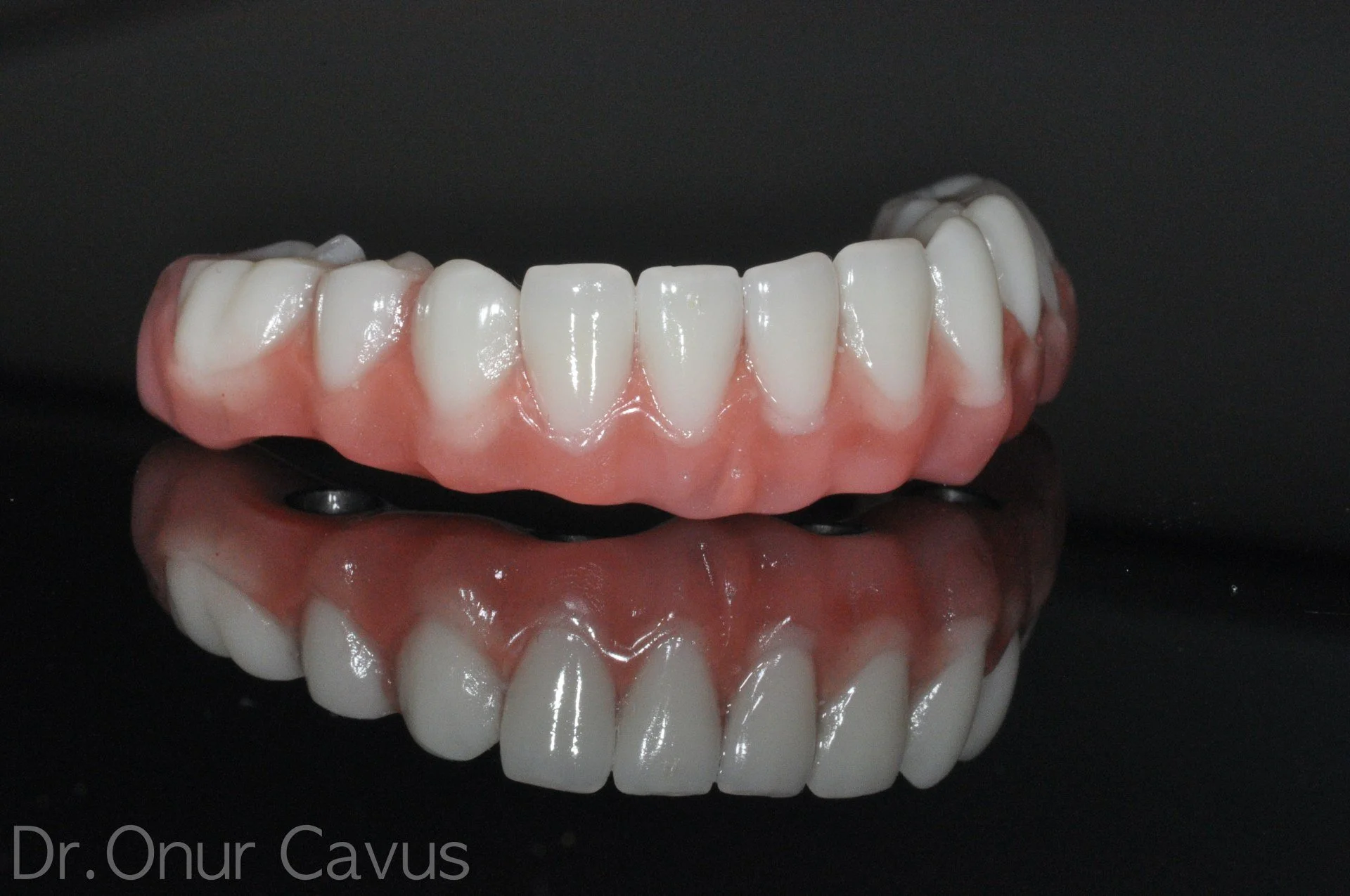
An All-on-4 full arch lower jaw denture with cleansable margins
Daily Hygiene for Fixed Full-Arch Bridges
Water Flossers and Oral Irrigators
Water flossers are highly effective for patients with full-arch restorations. They deliver a pressurised stream of water that removes debris and plaque from beneath the bridge, around each implant site, and along the gum margin.
To use a water flosser effectively: position the tip at a 45-degree angle to the implant-gum interface, aim for the space between the bridge and the tissue, and use a gentle pulsing motion. Work systematically around all implant sites, including the undersurface of the bridge. Use this at least once daily, ideally in the evening.
Interdental Brushes
Interdental (interproximal) brushes are small, bottle-brush-shaped tools that fit between the bridge and the implant abutments. Selecting the correct size is important—the brush should fit snugly without forcing.
Begin with a size that feels comfortable, usually between 0.6 mm and 1.5 mm depending on your restoration. Gently insert the brush under the bridge at each implant site and use short, gentle horizontal or vertical motions. Avoid twisting or forcing the brush, as this can damage the gum tissues. Use interdental brushes once daily.
Soft-Bristle or Electric Toothbrush Technique
Brush the outer surfaces of the bridge and the gum margin with a soft-bristled or electric toothbrush using gentle, circular motions. Pay special attention to the junction between the prosthesis and the gum tissue, where plaque readily accumulates. Brush for at least two minutes twice daily.
For the undersurface of the bridge, angle your toothbrush or water flosser tip upward to clean the area that rests closest to the gum tissue. This is often the most challenging area to reach but is also where peri-implantitis typically begins.
Floss Threaders and Super-Floss
In some cases, traditional floss or super-floss (thicker, stranded floss material) threaded through a needle-like loop can access proximal areas between the bridge and bone. This technique requires practice and patience but may be helpful for additional plaque removal in specific areas. Ask your dental team to demonstrate the technique at your maintenance appointment.
Daily Hygiene for Removable Implant-Supported Overdentures
If your restoration is removable, maintenance is somewhat more straightforward. Remove your denture each evening and rinse it thoroughly under running water to remove loose food debris and plaque.
Soak the denture in a cleaning solution (denture cleaner tablets or gentle liquid soap in warm water) for at least 15 minutes. This softens and loosens biofilm. Using a soft denture brush, gently brush both the outer surface and the inner (fitting) surface that contacts your tissues. Avoid high-pressure water jets, which can damage the denture.
After cleaning, rinse the denture thoroughly and examine the inner surface and your gum tissues for signs of irritation or colour changes. Allow your tissues to rest—ideally leaving the denture out for 4–6 hours daily—to promote tissue health.
What to Avoid
Certain products and practices can damage your restoration or affect the surrounding tissues:
Abrasive toothpastes: Use only gentle, low-abrasive formulations. Avoid whitening or highly-gritty pastes that may scratch acrylic or zirconia surfaces.
Stiff or hard-bristled brushes: These can irritate gum margins and may scratch the prosthesis surface.
High-alcohol mouthwashes: Alcohol can dry tissues and may affect acrylic materials over time. Rinse with alcohol-free antiseptic solutions or saline if recommended by your dentist.
Smoking: Smoking impairs healing and significantly increases the risk of peri-implantitis and implant failure.
Professional Maintenance Schedule
Daily home care is the foundation, but professional monitoring and cleaning are equally important. Most patients with full-arch implants benefit from professional check-ups and cleaning every three to four months during the first year, then every six months thereafter.
During these appointments, your dentist examines the implant sites for signs of inflammation, assesses bone levels, checks the fit and stability of the restoration, and performs professional cleaning to remove calculus (hardened plaque) that home care cannot address. In most cases, professional cleaning requires local anaesthetic to ensure comfort and thorough access.
Your dental team may also perform radiographs periodically to monitor bone levels and detect early signs of problems that are not visible clinically.
Recognising When to Seek Help
Prompt attention to warning signs can prevent minor issues from becoming serious. Contact your dentist if you notice:
Persistent swelling, redness, or bleeding around implant sites
Increased pus discharge or drainage
Discomfort or pain when chewing or applying pressure
Mobility or movement of the restoration
Unusual taste or odour
Gum recession or significant changes in tissue appearance
Difficulty eating or speaking after a period of normal function
These symptoms may indicate peri-implantitis, implant failure, or a problem with the restoration itself. Early diagnosis and intervention can often prevent or limit bone loss.
Ongoing Support at Innova Dental
At Innova Dental in downtown Toronto, we recognise that implant treatment is a long-term commitment. Dr. Onur Cavus and our team are dedicated to supporting you through the full maintenance journey after your full-arch restoration is placed. We provide detailed hygiene instruction at placement, answer your questions at follow-up visits, and tailor our maintenance protocols to your individual anatomy and risk factors.
Whether your restoration is fixed or removable, we are here to help you achieve excellent long-term outcomes. Regular communication and adherence to a home care routine based on your restoration type can extend the life of your implants for decades.
FAQ: Oral Hygiene for Full-Arch Implants
Q: Can I use regular floss on a full-arch implant bridge?
A: Standard floss is generally not effective for cleaning under a full-arch bridge because the bridge sits very close to the gum tissue. Water flossers, interdental brushes, and floss threaders are far more practical for reaching the areas beneath the restoration. Your dentist can recommend the best tools for your specific restoration anatomy.
Q: How long does it take to clean my full-arch implants properly each day?
A: Most patients need 5 to 10 minutes for a thorough daily routine. This typically includes brushing with a soft toothbrush, using a water flosser to clean around and beneath the bridge, and using interdental brushes at each implant site. Spending adequate time on these steps is far more important than speed.
Q: What should I do if my gums bleed during cleaning?
A: Light bleeding when you first begin using water flossers or interdental brushes may occur as inflamed tissue begins to heal. However, persistent or heavy bleeding is not normal and may indicate early peri-implantitis or trauma to the tissues. Contact your dentist to discuss your cleaning technique and to rule out infection.
Q: Can peri-implantitis be treated, or will I lose my implant?
A: Early peri-implantitis can often be managed with improved hygiene, professional cleaning, and in some cases, antibiotics or antimicrobial therapy. However, advanced peri-implantitis with significant bone loss is much more difficult to treat and may result in implant loss. This is why prevention through excellent daily care and regular professional monitoring is so important.
This article is for informational purposes only and does not constitute dental or medical advice. For personalised guidance, consult a qualified dental professional.