

— ORAL SURGERY — TORONTO
Wisdom Teeth
Removal in Toronto
Comfortable wisdom tooth removal in downtown Toronto, near the University of Toronto and Toronto Metropolitan University. Simple and surgical extractions performed by Dr. Onur Cavus, with IV sedation available so the procedure is fully comfortable from start to finish.
1 Visit
All four wisdom teeth can often be removed in a single appointment under IV sedation
20+
Years of clinical experience including complex surgical extractions
IV
Sedation available for simple and surgical extractions
— THE COMMON CASE
Most Wisdom Tooth Removals Are Straightforward
For most people in their late teens and early twenties, wisdom tooth removal is a routine, well-tolerated procedure. The tooth is assessed, the area is fully numbed, and the extraction is completed in a single appointment. Many patients choose IV sedation simply because it makes the experience relaxed and largely unremembered, even when the case is simple.
Whether a tooth needs to come out at all depends on the clinical situation, not on age or the fact that the tooth exists. Some wisdom teeth are best left in place and monitored. Others are better removed before they cause a problem. A short consultation with imaging settles which applies to you.
— ABOUT THE PROCEDURE
When Wisdom Teeth
Need to Come Out
Wisdom teeth are the last teeth to erupt, typically in the late teens or early twenties. In many patients they cause no problems and can be monitored without intervention. In others, they become a source of ongoing clinical concern that warrants removal.
The decision to remove a wisdom tooth is based on clinical assessment and radiographic examination. Common indications include impaction, recurrent pericoronitis, decay in an inaccessible position, pressure on adjacent teeth, and cyst formation around an unerupted tooth. In some cases removal is recommended prophylactically when a problematic eruption pattern is clearly developing.
At Innova Dental, wisdom tooth extractions — both simple and surgical — for both erupted and impacted teeth are performed by Dr. Onur Cavus, who has 20 years of experience in impacted wisdom teeth surgery.

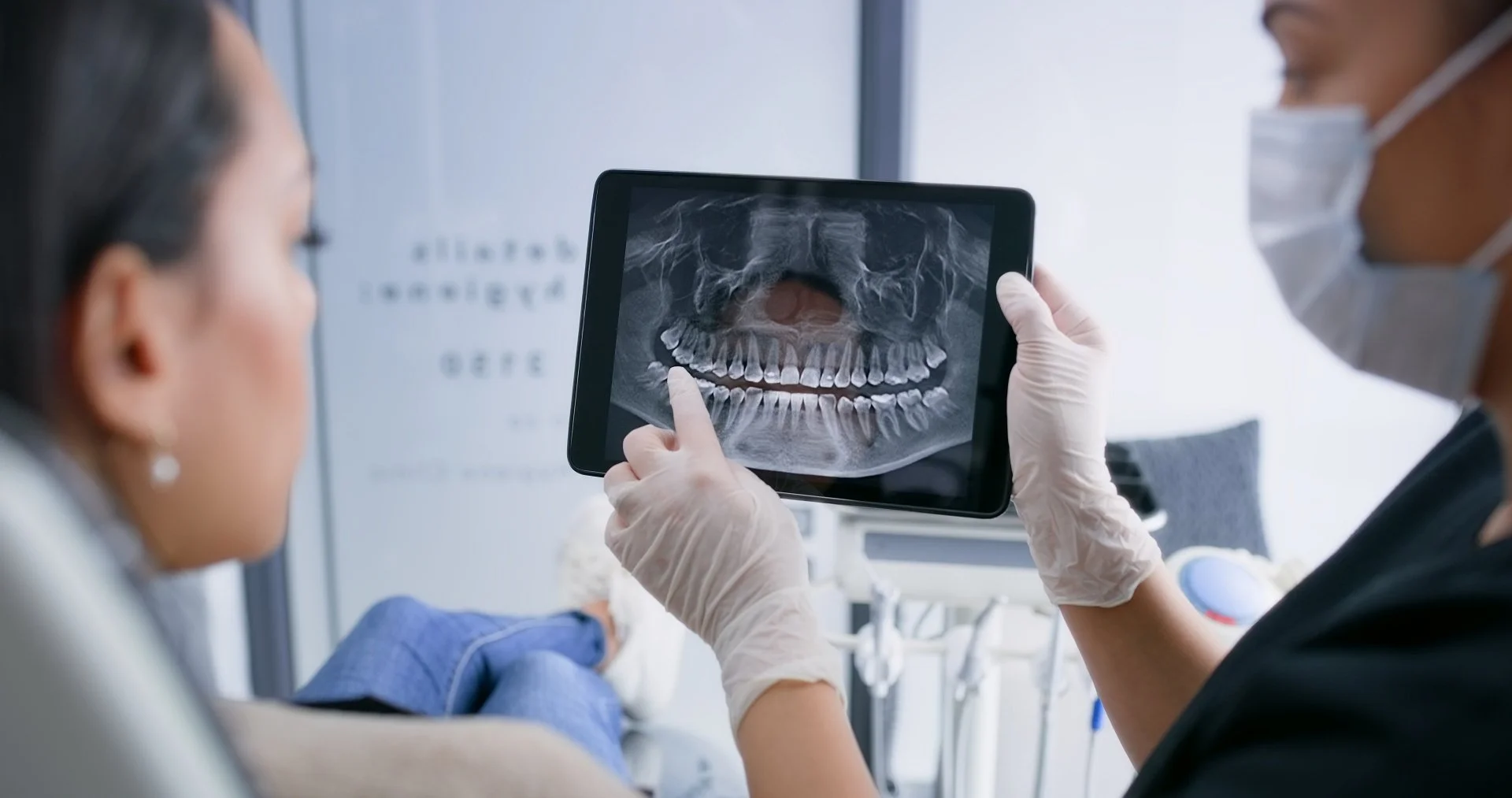
Panoramic dental X-ray showing impacted wisdom teeth in the upper and lower jaws.
Common Reasons for Removal
Partial or full impaction — tooth unable to erupt into normal position
Recurrent infection or swelling around the gum flap (pericoronitis)
Decay on the wisdom tooth or the adjacent molar it is pressing against
Crowding or pressure affecting neighbouring teeth
Cyst or follicular pathology identified on X-ray
Wisdom tooth preventing completion of orthodontic treatment
Pain or discomfort with no viable conservative management
Not every wisdom tooth needs to come out. Fully erupted, symptom-free wisdom teeth that are accessible for cleaning can often be monitored indefinitely. Removal is recommended only when there is a clear clinical indication — current or anticipated. This is assessed at a dedicated consultation with radiographic review.
— PROCEDURE TYPES
Simple vs Surgical
Extraction
The difference between a simple and a surgical extraction is determined by whether the wisdom tooth has fully erupted and is accessible, or whether it is impacted — partially or fully enclosed within the gum or bone. Simple extractions require no incision; surgical extractions do.
The type of extraction required depends on how the tooth has erupted and its position in the jaw. Both are performed at Innova Dental under appropriate anaesthesia.
Type 01 Simple Extraction
A simple (non-surgical) extraction is performed on a wisdom tooth that has fully erupted through the gum and is accessible with standard instruments. The tooth is loosened with an elevator and removed with forceps under local anaesthetic. No incision is required.
Tooth fully visible above the gum line
No bone removal required
Local anaesthetic with/without minimal sedation in most cases
Shorter procedure and recovery time
IV sedation available on request
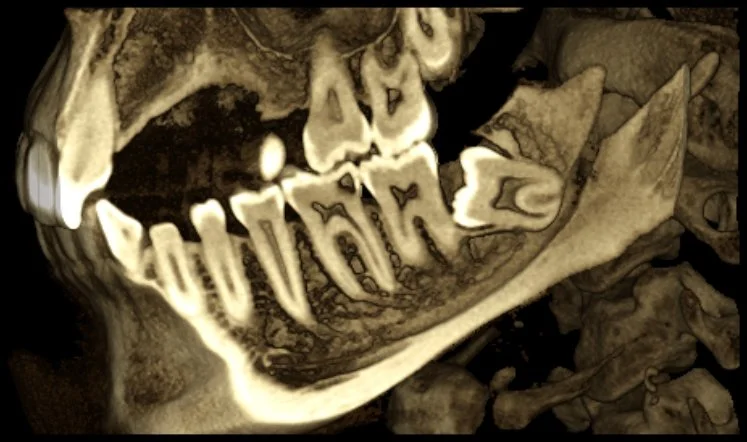
CBCT imaging of an impacted lower wisdom tooth and its proximity to the mandibular nerve.
Type 02 Surgical Extraction
A surgical extraction is required when the wisdom tooth is partially or fully impacted — meaning it has not fully erupted and is positioned within the gum or bone. An incision is made, bone may be removed to access the tooth, and the tooth is often sectioned before removal. The site is sutured after extraction.
Partially or fully impacted tooth
Requires incision and often bone removal
Tooth may be divided into sections for safe removal
Sutures placed at the end of the procedure
IV sedation strongly recommended for comfort
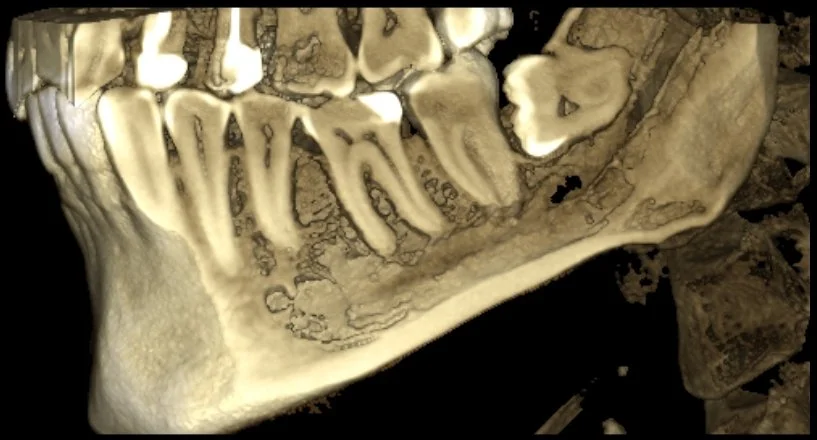
CBCT imaging used to evaluate impacted wisdom teeth and surrounding anatomy before surgery
— SEDATION OPTIONS
Comfortable from
Start to Finish
Sedation for wisdom tooth removal is available at Innova Dental in three forms: local anaesthetic only, nitrous oxide combined with local anaesthetic, and intravenous sedation combined with local anaesthetic. The appropriate option depends on the procedure type, patient anxiety, and personal preference.
Wisdom tooth removal — particularly surgical extraction of impacted teeth — is one of the most common procedures for which patients request sedation. At Innova Dental, IV sedation is available for any extraction, simple or surgical.
IV sedation produces a relaxed, amnesic state. Most patients have little or no recollection of the procedure. You remain responsive but are entirely comfortable throughout. A responsible adult must accompany you to and from the appointment.
Local Anaesthetic Only
Standard for simple extractions and suitable for many surgical cases. The area is completely numb. You are awake and aware throughout but should feel no pain — only pressure and movement.
Nitrous Oxide + Local Anaesthetic
Combined with local anaesthetic for pain control. A lighter option than IV sedation — you will be relaxed but awake.
IV Sedation + Local Anaesthetic
Intravenous sedation administered by Dr. Cavus, with extensive clinical experience in conscious IV sedation, authorised by the RCDSO as an IV sedation provider. Produces amnesic level of relaxation. The preferred option for surgical extractions and highly anxious patients. Escort required.
— STUDENTS & FIRST-TIME PATIENTS
Planning Your Wisdom Teeth Around School
Innova Dental is in downtown Toronto, close to the University of Toronto and Toronto Metropolitan University. If your own dentist has told you your wisdom teeth should come out, you can be assessed and treated here without a referral.
Timing around your term
Many students plan removal for a reading week, the end of term, or the summer. Recovery from a routine extraction is usually a few days — most class- or desk-based study resumes within a day or two; plan two to three days after a surgical extraction with IV sedation.
All four in one visit
Under IV sedation, all four wisdom teeth can often be removed in a single appointment — one recovery period instead of several.
Insurance & cost
You receive a written treatment plan and an estimate before anything is booked. With a student, employer, or family plan we can prepare a pre-determination so you know your cost in advance. International students on a university health plan and patients paying directly are welcome.
Bring an escort
If you choose IV sedation, a responsible adult must take you home, and you cannot drive afterward.
— WHAT TO EXPECT
From Consultation
to Recovery
Wisdom tooth removal at Innova Dental follows a structured five-stage process: consultation and imaging, treatment planning and sedation discussion, the procedure itself, immediate post-operative care, and a follow-up appointment to confirm healing. The consultation and extraction are typically scheduled as separate appointments.
Wisdom tooth removal at Innova Dental follows a consistent clinical process designed to ensure the right decision is made before any procedure is performed, and that recovery is managed with clear guidance afterward.
The consultation and the extraction are typically separate appointments. This allows time to review imaging, discuss sedation preferences, and ensure any pre-operative instructions are understood before the day of the procedure.
01 Consultation & Imaging
A clinical examination and panoramic or CBCT radiograph to assess the position, angulation, and root anatomy of the wisdom tooth. This determines whether extraction is indicated and what type of procedure is required.
02 Treatment Planning & Sedation Discussion
The recommended procedure is explained, including risks and expected recovery. Sedation options are discussed and a preference recorded. Pre-operative instructions are provided — fasting requirements apply if IV sedation is chosen. A consent form is signed before the procedure appointment is booked.
03 Day of Procedure
For IV sedation cases, an escort must be present. The sedation or local anaesthetic is administered, and the extraction is carried out once the area is fully numb. Surgical sites are sutured. The procedure typically takes between 20 and 60 minutes depending on complexity.
04 Immediate Post-Operative Care
Written post-operative instructions are provided before you leave. Gauze is placed over the extraction site. For sedation cases, you remain in the clinic until you are stable for discharge. IV sedation patients must not drive or operate machinery for 24 hours.
05 Recovery & Follow-Up
Swelling and discomfort typically peak at 48 to 72 hours and resolve progressively over the following week. Sutures, if placed, are typically removed or dissolve within 7 to 10 days. A follow-up appointment confirms healing and addresses any concerns.
— RECOVERY GUIDE
What to Do
After Extraction
After wisdom tooth removal, most patients experience swelling and discomfort for three to seven days. The most important post-operative instructions are to avoid rinsing, spitting, or using a straw in the first 24 hours, to keep the head elevated, and to take pain medication before the local anaesthetic wears off.
Post-operative care significantly affects how quickly and comfortably you recover. Written instructions are provided at every extraction appointment at Innova Dental. The guidance below gives a general picture of what recovery involves.
Any concerns during recovery — particularly signs of infection or dry socket — should be reported to the clinic promptly rather than left to resolve on their own.
Contact the Clinic If You Experience
Severe or worsening pain after 72 hours, particularly a deep, throbbing ache in the socket
Fever, spreading swelling, or difficulty opening your mouth beyond the first 48 hours
Bleeding that does not slow with sustained gauze pressure
Numbness or altered sensation persisting beyond the expected anaesthetic window
Signs of infection — pus, foul taste, or progressive swelling
First 24 Hours
Bite firmly on gauze for 30–45 minutes after leaving the clinic
Avoid rinsing, spitting, or sucking through a straw
Keep your head elevated — avoid lying flat
Apply ice to the outside of the face in 20-minute intervals
Take prescribed pain medication before anaesthetic wears off
Soft foods only — avoid the extraction site
No smoking or alcohol for at least 48 hours
What Is Normal
Swelling, bruising, and stiffness of the jaw
Mild to moderate pain managed with over-the-counter analgesics
Some oozing or pinkish saliva in the first few hours
Mild earache or throat soreness on the affected side
Difficulty opening the mouth fully for a few days
Days 2–7
Gently rinse with warm salt water after meals from day 2 onward
Continue soft diet — avoid hard, crunchy, or chewy foods
Swelling typically peaks at 48–72 hours then subsides
Some bruising on the cheek or jaw is normal and will resolve
Resume gentle tooth brushing — avoid the surgical site directly
Attend suture removal appointment if applicable
Dry Socket — What It Is
Occurs when the blood clot in the socket is lost before healing
Causes a deep, throbbing ache beginning 2–4 days after extraction
More common in smokers and after surgical extractions
Not an infection — but requires prompt treatment at the clinic
Treated with a medicated dressing placed in the socket
— PROCEDURE TYPES
Coronectomy
When Full Extraction Is Not Safe
A coronectomy is a surgical procedure in which the crown of a wisdom tooth is deliberately removed while the roots are left undisturbed in the jaw. It is performed specifically when the roots are in contact with the inferior alveolar nerve, where full extraction would carry a significant risk of permanent nerve damage.
In most cases a wisdom tooth is removed in its entirety. However, when the roots of a lower wisdom tooth are in direct contact with — or encroach upon — the inferior alveolar nerve (IAN), complete extraction carries a significant risk of permanent nerve damage. This can result in lasting numbness, altered sensation, or chronic pain affecting the lower lip, chin, and teeth on the affected side.
In these cases, coronectomy — the deliberate removal of the crown of the tooth while leaving the roots undisturbed in the bone — is a recognised and evidence-supported alternative. By avoiding manipulation of the roots entirely, the risk of nerve injury is substantially reduced. The retained roots typically migrate away from the nerve canal over time and rarely cause subsequent problems.
The decision to perform a coronectomy rather than a full surgical extraction is made on the basis of CBCT imaging, which provides a three-dimensional view of root position relative to the nerve canal. This relationship cannot be accurately determined from a standard panoramic X-ray alone — volumetric imaging is required before this decision can be made responsibly.
Coronectomy is not a compromise. It is a deliberate clinical decision made to protect the patient from a foreseeable and potentially permanent complication. In appropriately selected cases, it produces equivalent symptom resolution to full extraction — without the nerve risk.
The retained roots are reviewed radiographically at follow-up. In the rare event that they cause subsequent problems, staged removal can be considered once nerve proximity has reduced.
Indications for Coronectomy
Root apex in direct contact with the inferior alveolar nerve canal on CBCT imaging
Narrowing, deflection, or darkening of the nerve canal at the root apex on panoramic imaging — prompting CBCT review
Roots passing through or wrapping around the nerve canal
Patient informed of IAN risk and in agreement with a nerve-sparing approach
No active infection at the surgical site — acute pericoronitis is a contraindication
Tooth is not carious to root level — the crown must be cleanly separable from the roots
When Coronectomy Is Not Appropriate
Active infection or abscess at the surgical site
Some horizontally impacted tooth — roots are more likely to mobilise during crown removal
Caries extending to pulp level — infected root remnants cannot be safely retained
Follicular pathology requiring complete removal of the tooth
Patient unable to commit to radiographic follow-up — retained roots require monitoring
Coronectomy removes the crown of a wisdom tooth while leaving the roots in place when the tooth is very close to the mandibular nerve.
— FAQ
Wisdom Teeth
Questions
Questions about your specific situation are best answered at a consultation, where your X-rays and clinical presentation can be reviewed directly.
-
Cost depends on how many teeth are removed, whether the extraction is simple or surgical, and the sedation chosen. You receive a written estimate before anything is booked, and we can submit a pre-determination to your insurer so you know your out-of-pocket cost in advance.
-
Many student and university health plans include some oral surgery coverage. We'll review your plan and prepare a pre-determination before your appointment. Patients paying directly are also welcome.
-
For a simple extraction, many patients return the next day. For a surgical extraction with IV sedation, plan two to three days. Avoid strenuous activity for about a week.
-
In some cases, yes — particularly when IV sedation is being used, removing all symptomatic wisdom teeth in a single appointment reduces the total number of procedures and recovery periods. Whether this is appropriate depends on the complexity of each tooth and the overall clinical picture, which is discussed at the consultation.
-
The procedure itself should not be painful. The area is fully anaesthetised before any extraction begins. You will feel pressure and movement but not pain. If you feel anything sharp during the procedure, you are instructed to signal immediately so additional anaesthetic can be given. Post-operative discomfort is normal and is managed with prescribed or over-the-counter analgesics.
-
No. Fully erupted, accessible wisdom teeth that are free of decay and can be cleaned effectively do not need to be removed. The decision is based on clinical assessment and imaging — not a blanket policy. Removal is recommended only when there is a current or clearly anticipated clinical problem that cannot be managed conservatively.
-
Most patients feel significantly better within 3 to 5 days of a simple extraction and within 5 to 7 days of a surgical extraction. Full tissue healing takes several weeks. Recovery speed varies by individual and is influenced by extraction complexity, compliance with post-operative instructions, and whether any complications occur.
-
Dry socket occurs when the blood clot that forms in the extraction socket is lost or breaks down before the site has healed — exposing the underlying bone. It causes a distinctive deep, throbbing ache that typically begins 2 to 4 days after the procedure. It is more common after surgical extractions and in patients who smoke. It is treated at the clinic with a medicated dressing and resolves fully with appropriate management.
-
A coronectomy is the deliberate removal of the crown of a wisdom tooth while leaving the roots in place. It is performed when the roots are in close proximity to or in contact with the inferior alveolar nerve — the nerve running through the lower jaw that supplies sensation to the lower lip, chin, and teeth. Removing roots in this position risks permanent nerve damage, including lasting numbness or altered sensation. By leaving the roots undisturbed, coronectomy eliminates this risk while still resolving the clinical problem caused by the crown. CBCT imaging is required to confirm nerve proximity before this decision is made. Not every case is suitable — active infection, horizontal impaction, and root-level decay are contraindications.
— BOOK A CONSULTATION
Wisdom Tooth Concerns?
Let's Take a Look.
Book a consultation at Innova Dental. Dr. Cavus will review your imaging, assess the clinical situation, and give you a clear recommendation — without pressure to proceed.