

— ORAL SURGERY - TORONTO
Sinus Lift
in Toronto
When the upper jaw lacks the bone height needed for dental implants, a sinus lift creates it. By elevating the maxillary sinus membrane and introducing bone graft material beneath it, the procedure restores the vertical foundation that makes implant placement safe and predictable.
CBCT
3D imaging for precise surgical planning
20+
Years of clinical experience including complex sinus augmentation
IV
Sedation available — lateral window and crestal approaches
— WHY THE UPPER JAW IS DIFFERENT
When the Sinus Gets
in the Way of Implants
The maxillary sinuses are air-filled cavities that sit directly above the upper back teeth — the premolars and molars. In a dentate patient, the roots of these teeth occupy the space between the sinus floor and the jaw ridge, maintaining bone volume in this region.
When upper back teeth are lost, two things happen simultaneously: the jawbone begins to resorb from below, and the sinus tends to expand downward — a process called pneumatization — into the space the roots once occupied. Over time, the distance between the sinus floor and the crest of the jaw ridge can become insufficient for a standard implant, which requires a minimum depth of bone to achieve stable fixation.
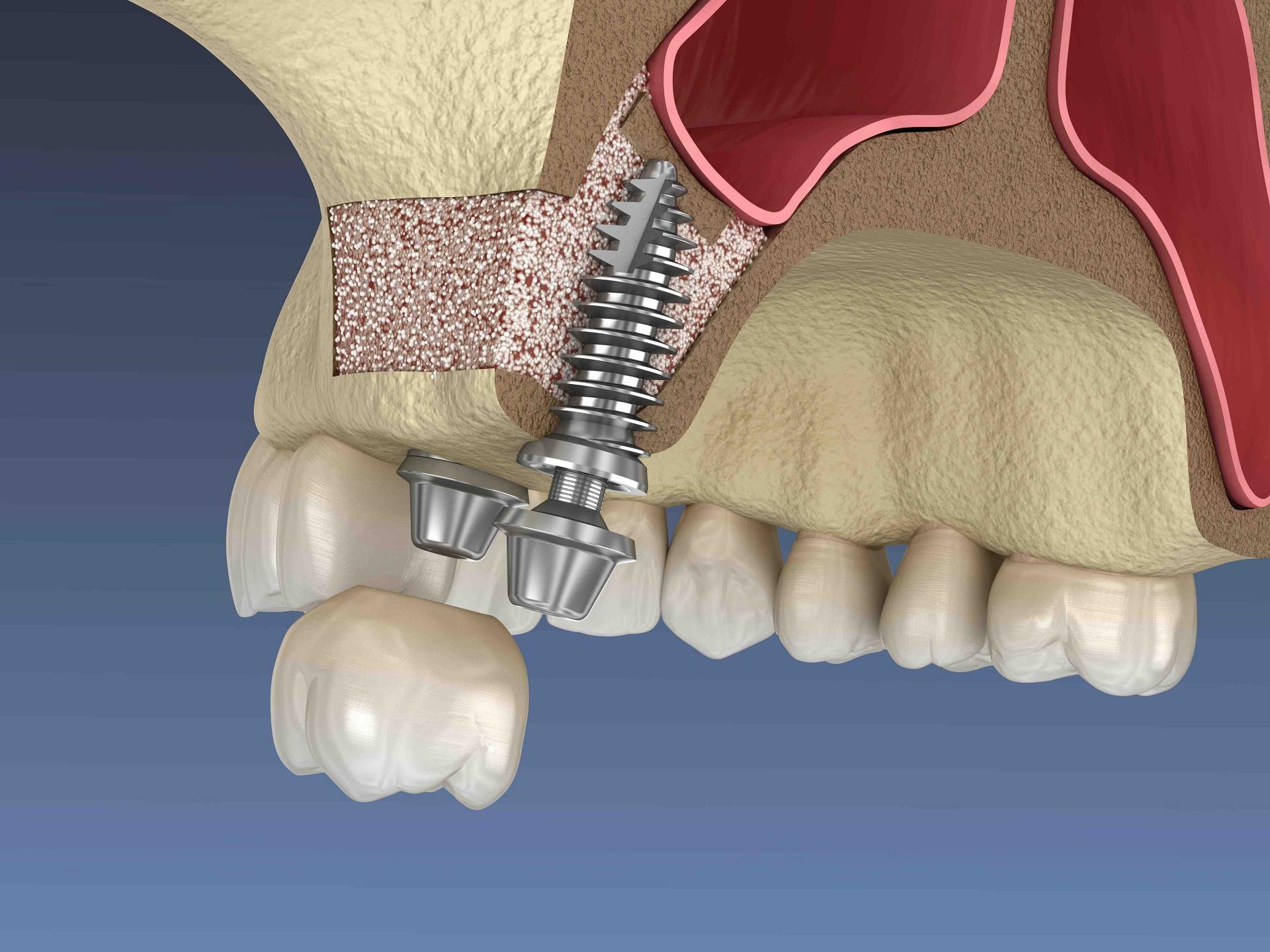
A sinus lift — formally called maxillary sinus augmentation — addresses this directly. The sinus membrane is carefully elevated, bone graft material is introduced into the space beneath it, and over a healing period of several months, new bone forms to create the height needed for implant placement.
WHO TYPICALLY NEEDS A SINUS LIFT
Missing one or more upper premolars or molars
Insufficient bone height in the posterior maxilla for implant placement (typically less than 8–10mm)
Sinus has expanded (pneumatized) following tooth loss
Significant bone resorption from longstanding tooth absence in the upper back jaw
Previous failed implant attempt in the upper back jaw due to insufficient bone volume
A flat X-ray is not enough. The relationship between the sinus floor and the jaw ridge cannot be accurately assessed from a panoramic radiograph alone. CBCT (cone beam CT) imaging is required to measure available bone height, assess sinus membrane thickness, and identify any sinus pathology before treatment planning begins.
— SINUS LIFT TECHNIQUES
Two Techniques —
Matched to Your Anatomy
The appropriate approach is determined by the amount of bone height available beneath the sinus floor, measured precisely from CBCT imaging at your consultation.
01Lateral Window Approach
A small window is created in the lateral wall of the sinus, through the cheekbone side of the upper jaw. Through this opening, the Schneiderian membrane — the thin lining of the sinus — is carefully elevated away from the sinus floor using specialised instruments. Bone graft material is then packed into the space created between the elevated membrane and the sinus floor.
The window is covered with a collagen membrane and the gum tissue is sutured closed. Over the healing period, the graft integrates with existing bone and new bone forms throughout the augmented space.
Key Details
Requires 6–9 months of healing before implant placement
Simultaneous implant placement possible if ≥4–5mm bone exists for primary stability
More extensive procedure — IV sedation strongly recommended
Swelling around cheek and eye area for 3–5 days post-operatively
Avoid nose blowing and forceful sneezing for 2 weeks
No straw use during initial healing period
02Crestal (Transcrestal) Approach
The crestal approach accesses the sinus floor through the same site where the implant will eventually be placed, rather than through a lateral window. Using osteotomes or piezoelectric instruments, the sinus floor is gently infractured upward, and a small amount of bone graft material is introduced through the osteotomy to lift the membrane.
Because the approach is less invasive and membrane elevation is more limited, it is appropriate only when the bone deficit is modest. In most cases, the implant can be placed simultaneously with the sinus lift in the same appointment.
Key Details
Less invasive than the lateral window approach
Implant placed simultaneously in most cases
Healing follows standard implant osseointegration protocol (3–6 months)
Suitable when bone height is sufficient for primary implant stability
Shorter recovery — swelling typically minimal
No lateral window — no cheek swelling or sinus precautions required
— TREATMENT TIMELINE
Simultaneous or Staged —
How the Decision Is Made
Whether implants are placed at the same appointment as the sinus lift, or in a separate procedure after healing, depends on one primary factor: whether sufficient existing bone height allows the implant to achieve primary stability at the time of placement.
This is not a preference — it is a clinical determination made from CBCT imaging and assessed intraoperatively. Your dentist will plan the approach at your consultation and confirm it on the day of the procedure.
Simultaneous Approach — Sinus Lift & Implant Together
When bone height is adequate (typically 4–5mm or more), the implant can be placed into the existing bone at the base of the augmented site at the same appointment, achieving primary stability while the sinus graft heals above. This reduces the total number of surgical appointments and the overall treatment timeline significantly.
Staged Approach — Sinus Lift First
When bone height is minimal (typically less than 4–5mm), there is insufficient bone to hold the implant firmly during the healing period. The sinus lift is performed first, the graft is allowed to mature over 6–9 months, and implant placement occurs once CBCT imaging confirms adequate bone density and volume. This approach adds to the total treatment timeline but ensures implant stability is not compromised.
The crestal approach almost always allows simultaneous placement. The lateral window approach may allow it depending on existing bone height — typically when ≥4–5mm of bone exists to anchor the implant below the augmented sinus space.
— SEDATION OPTIONS
Comfortable from
Start to Finish
Sinus lift surgery — particularly the lateral window approach — is one of the procedures for which patients most commonly request sedation. At Innova Dental, IV sedation is available for all sinus lift procedures and is strongly recommended for lateral window cases.
IV sedation produces a deeply relaxed, amnesic state. Most patients have little or no recollection of the procedure. You remain responsive but are entirely comfortable throughout. A responsible adult must accompany you to and from the appointment.
LOCAL ANAESTHETIC ONLY
Appropriate for crestal approach cases and some lateral window cases in patients who are comfortable with oral surgery under local anaesthetic. The area is completely numb. You will feel pressure and movement but not pain.
IV SEDATION + LOCAL ANAESTHETIC
Intravenous sedation administered and monitored by Dr. Cavus, who holds RCDSO certification as a moderate IV sedation provider. Produces a deep, amnesic level of relaxation. Strongly recommended for lateral window sinus lifts. Escort required.
— WHAT TO EXPECT
From Consultation
to Implant Placement
Sinus lift surgery at Innova Dental follows a structured clinical process. The consultation and the procedure are always separate appointments, allowing time for imaging review, surgical planning, and sedation discussion.
Healing is never assumed — CBCT imaging confirms bone maturation before implant placement proceeds.
01 Consultation & CBCT Imaging
CBCT imaging provides the three-dimensional view of sinus anatomy required to plan accurately. The scan measures available bone height, assesses sinus membrane thickness, identifies any sinus pathology requiring management, and determines which surgical approach is appropriate. A panoramic X-ray alone is insufficient for this assessment.
02 Treatment Planning
The recommended approach (lateral window or crestal), graft material, sedation preference, and overall implant timeline are discussed and documented. If IV sedation is chosen, fasting requirements and escort arrangements are confirmed. Consent is obtained before the procedure appointment is booked.
03 Surgical Appointment
Local anaesthetic is administered; IV sedation if chosen. The sinus lift is performed — lateral window or crestal — and graft material placed. For lateral window cases, a collagen membrane covers the window and the site is sutured. For crestal cases, the implant is typically placed at the same appointment. Written post-operative instructions are provided before discharge.
04 Healing & Integration
Lateral window cases: a follow-up at 6–8 weeks assesses early healing. CBCT imaging at 6–9 months confirms bone maturation before implant placement proceeds. Crestal cases with simultaneous implant: healing follows standard implant osseointegration protocol (3–6 months before loading).
05 Implant Placement
Once adequate bone volume and density is confirmed, implant placement proceeds in the newly formed bone at the augmented sinus site. Osseointegration then follows the standard timeline before the final crown or prosthesis is fitted. From sinus lift to final restoration, total treatment time for staged cases is typically 12–18 months.
— ABOUT SINUS LIFTA sinus lift — also called maxillary sinus augmentation or sinus floor elevation — is a bone grafting procedure that increases the amount of bone in the upper jaw (posterior maxilla) by elevating the floor of the maxillary sinus and placing bone graft material beneath the sinus membrane. It is performed when insufficient bone height exists in the upper back jaw to support dental implants, typically due to tooth loss followed by bone resorption and sinus pneumatization. Two primary approaches are used: the lateral window technique, for significant bone deficiency, which requires 6–9 months of healing before implant placement; and the crestal or transcrestal technique, for modest deficiency, which is often combined with simultaneous implant placement. Graft materials include autograft, allograft, xenograft, and alloplastic options. Sinus lift surgery is performed by oral surgeons, periodontists, and implant-trained dentists.— FAQ
Sinus Lift
Questions
Questions about your specific anatomy and implant options are best answered at a consultation with CBCT imaging review.
-
A sinus lift is a specific type of bone grafting procedure — it uses bone graft material to augment the floor of the maxillary sinus. All sinus lifts involve grafting, but not all bone grafts are sinus lifts. Other bone grafting procedures (socket preservation, ridge augmentation, GBR) address different sites and clinical needs. If your missing teeth are in the upper back jaw, a sinus lift is the relevant procedure; other areas require different approaches.
-
This is determined by the location of the missing tooth and the amount of available bone. Upper back teeth (premolars and molars) in close proximity to the maxillary sinus typically require sinus augmentation. Missing teeth in other areas may require ridge augmentation, socket preservation, or GBR. CBCT imaging at your consultation clarifies which procedure applies to your specific anatomy.
-
The procedure is performed under local anaesthesia — you will feel pressure and movement but not pain. Post-operatively, swelling around the cheek and eye area is expected for 3–5 days following a lateral window sinus lift and is managed with analgesics. The crestal approach involves considerably less post-operative swelling. IV sedation makes the procedure itself a non-event for most patients.
-
Avoid blowing your nose, sneezing forcefully, or creating negative pressure (no straws) for at least two weeks post-operatively. These activities can dislodge the membrane or displace the graft. If you need to sneeze, do so with your mouth open to equalise pressure without affecting the sinus. Written post-operative instructions are provided before you leave the clinic.
-
Membrane perforation is a recognised intraoperative complication that occurs in a minority of lateral window cases. When identified immediately, small perforations can often be managed with a resorbable membrane patch and the procedure completed. Larger perforations may require the procedure to be stopped and rescheduled after healing. This risk is discussed in full at the consent stage before your procedure is booked.
-
For staged lateral window cases — where the implant is placed in a separate appointment after sinus healing — total treatment time from the sinus lift procedure to the final crown is typically 12 to 18 months. For simultaneous cases (crestal approach or lateral window with adequate existing bone), the timeline is closer to 9 to 12 months total. Your treatment coordinator will map out the expected timeline at your consultation.
-
Sinus augmentation is typically classified under the oral surgery benefit of dental insurance plans, though coverage varies significantly by plan. Some plans provide partial coverage; others do not. Our treatment coordinator can prepare a predetermination letter to submit to your insurer before treatment begins, so you have a clear picture of expected out-of-pocket costs.
— BOOK A CONSULTATION
Ready to Discuss
Your Upper Jaw Options?
If you're missing upper back teeth and have been told implants aren't possible due to bone loss, a sinus lift consultation will clarify what's involved. Most cases are more straightforward than patients expect.