

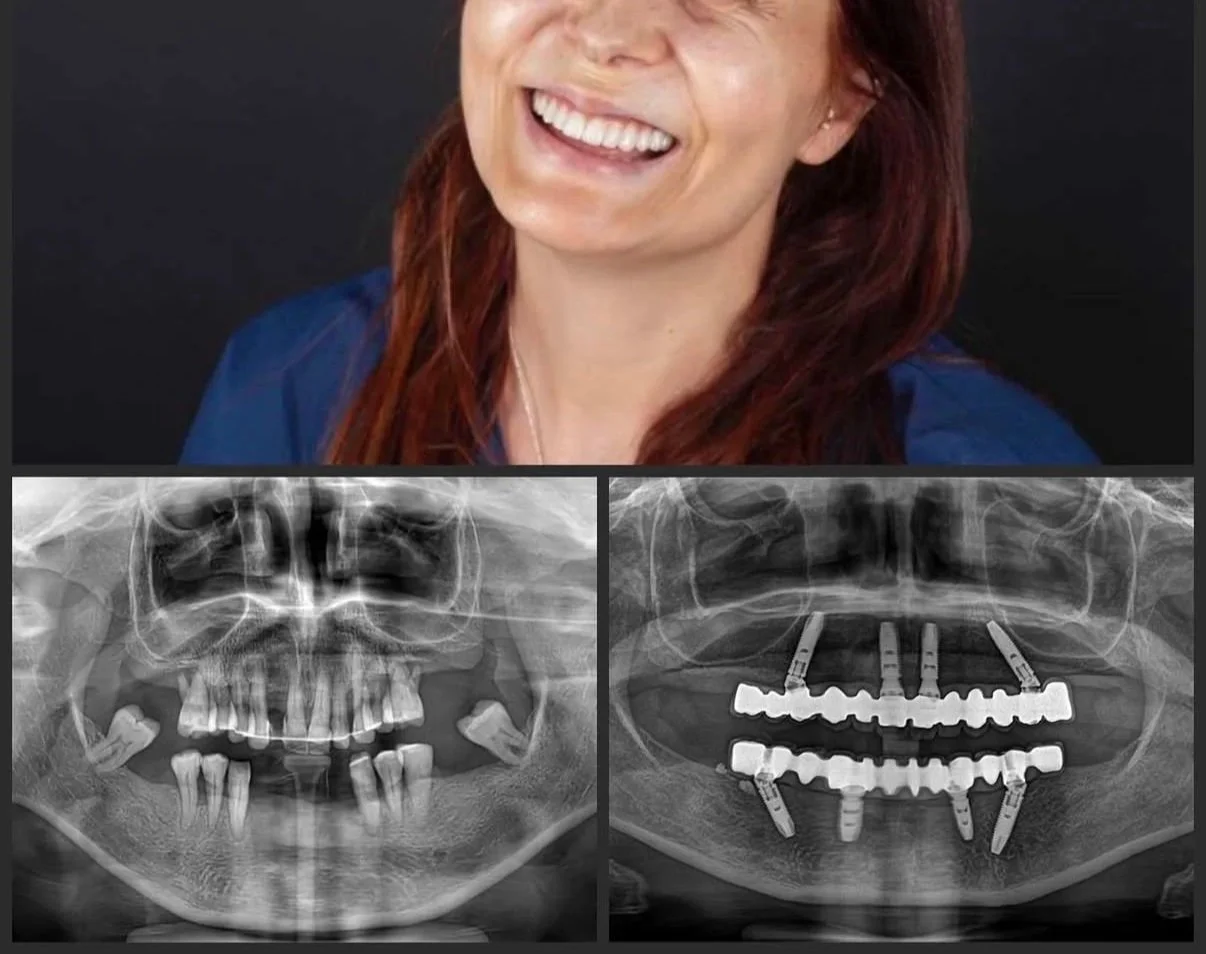
All-on-X Full Arch Implants in Toronto: A Complete Guide
All-on-4 and All-on-6 implant treatments offer a way to restore a full arch of teeth using just four or six strategically placed implants. This guide explains how full-arch implant rehabilitation works, who is a suitable candidate, how fixed prosthetics differ from removable overdentures, and what the treatment journey looks like from consultation through to final restoration.
If you have lost multiple teeth or are facing tooth extraction, you may have heard about All-on-4 and All-on-6 implant treatments. These solutions offer a practical way to restore a full arch of teeth using dental implants. At Innova Dental in Toronto, we provide comprehensive full-arch implant rehabilitation using these evidence-based approaches.
What Are All-on-X Dental Implants?
All-on-X full-arch implants represent a modern solution for replacing an entire row of teeth—upper, lower, or both—using a fixed or removable prosthesis supported by a small number of dental implants. In the most common approach, four strategically angled implants support a complete fixed denture; this is called All-on-4. Some cases benefit from six implants (All-on-6), offering additional support and stability. Rather than replacing each missing tooth with an individual implant, the All-on-X technique uses fewer implants positioned at specific angles to distribute forces evenly across the jawbone. A tooth-coloured prosthesis is then anchored permanently or removably onto these implants, restoring chewing function, appearance, and speech in a single restoration.
How All-on-X Implant Positioning Works
The Angled Implant Principle
The key innovation behind All-on-4 and All-on-6 treatments is implant positioning. Rather than placing all implants vertically, the outer two (or four, in All-on-6) are angled between 30 and 45 degrees. This strategic angulation offers several biomechanical advantages:
Increased bone contact: Angled implants can reach denser bone further back in the jaw, even when significant bone loss has occurred, avoiding the need for bone grafting in many cases.
Better load distribution: The angled positioning distributes chewing forces more evenly across the implant-supported structure.
Posterior cantilever span: Angled implants allow the prosthesis to extend back further, supporting more teeth without additional implants.
The central implants typically remain vertical to support the front teeth. This combination of vertical and angled implants creates a stable foundation that works with your natural jaw anatomy.
All-on-4 Versus All-on-6
All-on-4 uses four implants: two vertical in the front and two angled at the back. This approach is suitable for many patients, particularly those with good general health and adequate bone volume.
All-on-6 places six implants in a similar pattern but with additional support in the molar regions. The extra implants can provide greater stability and longevity, particularly for patients who grind their teeth, have specific bone anatomy, or prefer maximum long-term durability. Your dentist will recommend which approach suits your situation based on bone structure, health history, and individual needs.
Full-Arch Implant Options: Fixed or Removable
All-on-X treatments come in two main configurations, each with distinct advantages.
Fixed Hybrid or Composite Prosthetics
A fixed prosthesis is permanently secured to the implants via screws or cement. You cannot remove it yourself. Benefits include:
Appearance identical to natural teeth
No daily removal or cleaning routine beyond normal brushing and flossing
Improved speech and eating comfort compared to removable options
Psychological confidence of a permanent restoration
Maintenance involves standard oral hygiene plus regular professional cleaning. If repairs are needed, your dentist may need to access the screw holes or remove sections of the prosthesis.
Removable Implant-Supported Overdentures
A removable prosthesis (overdenture) clicks or snaps onto the implants, held in place by special attachments. Advantages include:
Lower initial cost than fixed prosthetics in most cases
Easier for patients to clean and maintain at home
Simpler repairs and adjustments
Less complex laboratory and clinical fabrication
The trade-off is daily removal, cleaning, and reinsertion, similar to a traditional denture but more stable and functional.
Your dentist will discuss which option aligns with your preferences, budget, bone anatomy, and lifestyle.
Who Is a Candidate for All-on-X Implants?
Ideal candidates for full-arch implant treatment typically have these characteristics:
Multiple missing teeth or teeth requiring extraction in one or both arches
Adequate jawbone volume and density, though angled implants can work even when some bone loss has occurred
Good general health, without uncontrolled diabetes, active periodontal disease, or other conditions that compromise healing
Realistic expectations about treatment duration, outcomes, and ongoing care
Commitment to oral hygiene and maintenance throughout the implant's lifespan
Stable medication profile — certain medications may affect bone healing and should be reviewed during consultation
If you have significant bone loss, your dentist may recommend bone grafting before implant placement. Other factors, such as smoking or heavy teeth grinding, may influence your suitability and will be assessed during your consultation.
The Role of IV Sedation in Full-Arch Treatment
Full-arch implant placement is a lengthy surgical procedure, often taking several hours. Many patients find conscious moderate IV sedation beneficial during this phase of treatment.
IV sedation places you in a deeply relaxed, amnesic state—you remain conscious and responsive, but have no recall of the procedure and experience minimal discomfort. This is distinct from general anaesthesia, where you are fully asleep. At Innova Dental, Dr. Cavus is RCDSO-certified in moderate IV sedation and can administer this safely in our clinic.
IV sedation during implant placement offers:
Reduced anxiety and stress during the procedure
Amnesia of the surgical experience
Ability for longer appointments without fatigue or movement
Better surgical conditions for the dentist due to patient comfort and stillness
IV sedation is not suitable for everyone and requires thorough assessment of your health history, medications, and ability to arrange post-operative care. Your dentist will discuss whether moderate sedation is appropriate for you.
The Full-Arch Implant Treatment Journey
Consultation and Planning
Your first appointment involves comprehensive assessment: examination of your teeth and bone, imaging (often including CBCT), discussion of your goals, and review of medical history. If IV sedation is under consideration, additional screening occurs. You will receive a detailed treatment plan, cost estimate, and timeline.
Implant Placement
The surgical phase places the implants into the jawbone under local anaesthesia (with or without IV sedation, depending on your plan). The gums are carefully sutured, and a healing period of several months follows while bone integrates with the implant surfaces. Many patients receive a temporary prosthesis immediately or very shortly after implant placement, allowing them to maintain function and appearance during healing.
Prosthesis Fabrication
Once osseointegration is complete (typically 4–6 months), impressions are taken and the final fixed or removable prosthesis is designed and fabricated. This phase may involve multiple appointments for fit adjustments and colour matching.
Delivery and Adjustment
The final prosthesis is secured to the implants, and adjustments are made to ensure comfortable biting and proper alignment. Your dentist will provide detailed instructions for cleaning and maintenance.
Long-Term Care
After delivery, regular check-ups (typically every 6 months) monitor implant health and prosthesis condition. Professional cleaning removes tartar and plaque in areas difficult to reach at home. With consistent care, full-arch implants often remain functional for 10–15 years or longer.
Choosing Full-Arch Implants in Toronto
Innova Dental, located in downtown Toronto, offers comprehensive full-arch implant rehabilitation. Dr. Onur Cavus is a general dentist with extensive clinical experience in implant dentistry, and certified to administer moderate IV sedation.
Whether you are exploring full arch implants Toronto for the first time or seeking a second opinion, our team is here to answer your questions and develop a treatment plan tailored to your needs.
For further information about dental implants at Innova Dental or to discuss IV sedation dentistry, contact us at smile@innovadental.ca or schedule a consultation.
Frequently Asked Questions
How long does the entire All-on-4 process take?
The total timeline typically spans 6–9 months from consultation to final prosthesis delivery. Implant placement itself is a single surgical appointment (2–4 hours), followed by 4–6 months of bone healing. Prosthesis design and fabrication usually takes 4–8 weeks. Some patients receive a temporary prosthesis immediately after implant placement, allowing them to maintain function and appearance during healing.
Can I eat normally with All-on-X implants?
Yes, most patients regain substantially normal chewing ability once the final prosthesis is delivered and the healing period is complete. Initially (during the first few weeks after implant placement), a soft diet is recommended. Once your dentist confirms that bone has integrated with the implants, you can typically eat most foods. Extremely hard or sticky foods should be avoided, as they can damage the prosthesis.
What is the cost of All-on-4 implants in Toronto?
Cost varies depending on implant materials, prosthesis type (fixed or removable), bone grafting requirements, use of IV sedation, and clinical complexity. At Innova Dental, a detailed cost estimate is provided during your consultation after examining your specific situation. Many dental insurance plans cover a portion of implant-related treatment; your dentist can review your coverage and discuss financing options.
Are All-on-X implants permanent?
Dental implants themselves can last 20–30 years or longer with consistent care; some remain stable for a lifetime. The prosthesis (the artificial teeth) typically lasts 10–15 years before needing repair, refurbishment, or replacement due to normal wear and material fatigue. Regular maintenance and professional cleaning significantly extend the lifespan of both implants and prosthesis.
This article is for informational purposes only and does not constitute dental or medical advice. For personalised guidance, consult a qualified dental professional.